Filters quietly generating thousands of URLs
Faceted navigation spawns near-identical combinations that consume crawl budget while the collections that actually sell wait to be recrawled.
Explicit indexation rules per facet, not a blanket blockCategory architecture, product page depth and Core Web Vitals connected to clean purchase events, so you can see which collections and templates actually carry revenue.
Certified and partnered
Faceted navigation spawns near-identical combinations that consume crawl budget while the collections that actually sell wait to be recrawled.
Explicit indexation rules per facet, not a blanket blockProduct and listing templates carry the most traffic and the most third-party script. Slow loading costs conversion before it costs ranking, so it hides in the revenue line.
Template-level performance work, measured on field dataPurchase events firing twice, feeds drifting from the catalogue, ad platforms reporting numbers finance does not recognise. Every optimisation after that is guesswork.
Purchase event and feed reconciliationCategory structure, faceted navigation control and product schema at catalogue scale
→Margin-aware bidding and creative velocity with clean purchase signals
→Crawl budget, rendering and Core Web Vitals across product and listing templates
→End-to-end tracking across product page, cart, checkout and post-purchase
→Templates built for speed, with conversion paths tested rather than assumed
→Buying-guide coverage and product entities for answer-led discovery
→CRO, UX redesign and funnel work grounded in behavioural analytics rather than opinion, with the product and listing templates rebuilt around how people actually shop.
Read the case study →Performance marketing, funnel optimisation and creative testing rebuilt around landing experiences that match the ad promise.
Read the case study →De-indexing, hierarchy, schema and vitals shipped together across 150 days.
Read the case study →Individual results vary with starting position. These are the movements we see most consistently in this sector.
Most automation fails because it is bolted onto data nobody trusts. The version worth building sits on top of instrumentation that already reconciles, which is the part we install first.
Feeds go stale, purchase events start double-firing, and the ad platform quietly reports numbers the backend does not recognise. Nobody notices until a month of reporting is already wrong and the budget decisions made on it have shipped.
Built on your purchase event and feed reconciliation, so it reads data that already reconciles.
It does not fix the underlying template or feed logic. It tells you the moment one drifts.
Guides on category architecture, product page depth and turning discovery into revenue.

An E-commerce SEO guide for D2C brands. Improve category pages, PDPs, Core Web Vitals, structured data and conversions. Turn discovery into revenue.
Read the guide →
Category page SEO: structured content, faceted navigation rules, schema, UX design and ranking practices for high-intent ecommerce traffic.
Read the guide →
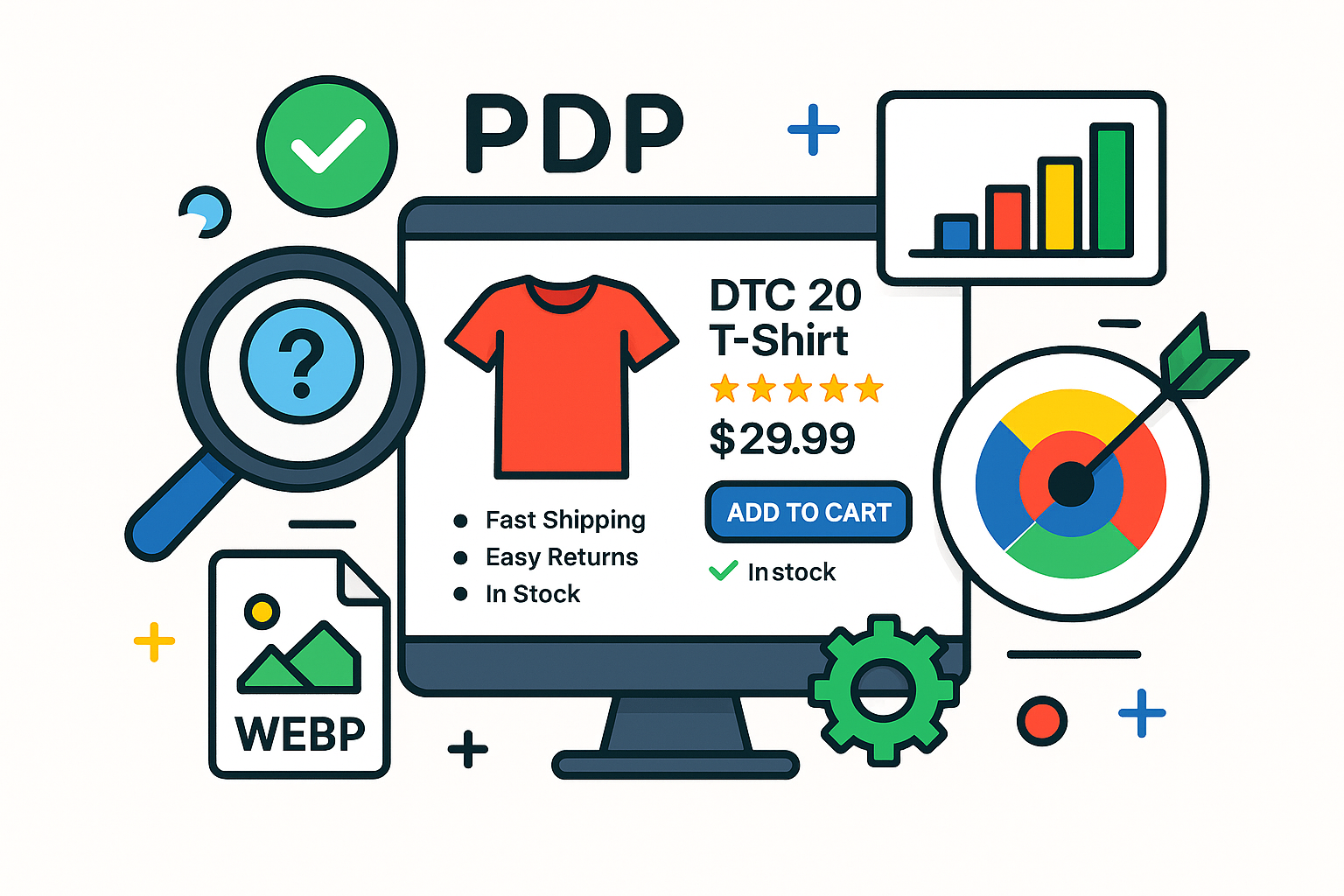
Optimize product pages for SEO, UX, speed, and conversions. Learn the complete 2025 PDP framework D2C brands use to increase revenue and…
Read the guide →A short call, then a written view of where the funnel leaks and what we would fix first.